
Table of Contents
- What Is a Rapid Health Test and How Do They Work?
- Understanding Diagnostic Sensitivity and Specificity
- The False Negative Rate of Rapid Tests and What It Means
- How to Interpret At-Home Test Results Correctly
- When to Follow Up With a PCR Test
- Factors That Affect Rapid Test Accuracy
- Making the Right Decision After Your Rapid Test Results
- Frequently Asked Questions
Last Updated: September 18, 2026
What Is a Rapid Health Test and How Do They Work?
A rapid health test is a point-of-care diagnostic tool designed to detect the presence of a pathogen or health marker in minutes rather than hours or days, and rapid health tests accurate results depend on proper collection and timing. These tests work by identifying antigens, specific proteins on the surface of pathogens, or by measuring other biological markers in a sample collected at home or in a clinical setting.
The mechanics are straightforward. You collect a sample (usually a swab or bodily fluid), apply it to a test strip or cartridge, and wait for a visible result. The test uses antibodies or other detection methods to bind to target antigens, producing a color change or line that indicates a positive or negative result. This rapid diagnostic test format has become popular because it eliminates the need for laboratory equipment and trained technicians, making testing accessible from your home.
However, the speed of rapid tests comes with a tradeoff. Because they rely on antigen detection rather than amplification of genetic material, they are generally less sensitive than molecular tests like PCR (polymerase chain reaction). This means a rapid test is more likely to miss an infection in its early stages or when viral load is low. Understanding this limitation is essential before you interpret your result.
Understanding Diagnostic Sensitivity and Specificity
Diagnostic sensitivity and specificity are the two most important metrics for evaluating any rapid health test's reliability. These terms describe how well a test performs at detecting true cases and avoiding false alarms.
Sensitivity measures the test's ability to correctly identify people who actually have the condition. A test with high sensitivity will catch most true infections. If a test has 85% sensitivity, it will correctly detect the condition in 85 out of 100 infected people, meaning 15 will receive a false negative result.
Specificity measures the test's ability to correctly identify people who do not have the condition. High specificity means fewer false positives. A test with 95% specificity will correctly identify 95 out of 100 uninfected people as negative, with 5 false positives.
The relationship between these two metrics matters. A test cannot be perfect on both measures simultaneously. Many rapid tests sacrifice some sensitivity to achieve high specificity, which means they are conservative, they rarely give false positives, but they may miss infections. This design choice reflects a clinical philosophy: a false positive causes unnecessary worry and follow-up testing, while a false negative might lead someone to spread infection unknowingly.
When evaluating are rapid health tests accurate, you need to know both numbers. A test advertised as "99% accurate" is meaningless without clarity on whether that refers to sensitivity, specificity, or overall accuracy across both infected and uninfected populations.
The False Negative Rate of Rapid Tests and What It Means
The false negative rate is the inverse of sensitivity. If a test has 80% sensitivity, its false negative rate is 20%, meaning 1 in 5 infected people will test negative despite having the condition.
False negatives are particularly concerning because they create false reassurance. Someone tests negative, believes they are uninfected, and continues their normal activities while potentially spreading infection. This is especially problematic during the incubation period, when viral load may be low but the person is still contagious.
Several factors influence the false negative rate. The timing of the test relative to infection onset matters significantly. Testing too early, before sufficient viral shedding has occurred, dramatically increases the risk of a false negative. Testing during peak viral load produces the most reliable results. As infection progresses and viral load declines, the risk of false negatives rises again.
The collection technique also affects results. A poorly collected sample may contain insufficient pathogen material, leading to a false negative even if the test itself is functioning correctly. Swab depth, angle, and duration all influence sample quality. Many people underestimate how thorough the collection process needs to be.
Environmental factors play a role too. Temperature, humidity, and storage conditions can degrade test reagents. A test stored in a hot car or damp bathroom may perform worse than one stored at room temperature in a dry environment.
How to Interpret At-Home Test Results Correctly
Interpreting your test result requires understanding what the visual outcome actually means. Most rapid tests show a control line and a test line. A control line appears if the test ran correctly; a test line appears if the target antigen was detected.
A positive result shows both lines. This indicates the test detected the pathogen and functioned properly. A negative result shows only the control line, meaning the test worked but found no antigen. An invalid result shows no control line, meaning the test failed and the result cannot be trusted, you need to retest.
The intensity of the test line does not indicate viral load or infection severity. A faint line is still positive. A darker line is not "more positive." The test is binary: either antigen is present or it is not. Interpreting line darkness as a measure of how sick you are is a common mistake that leads to poor decisions.
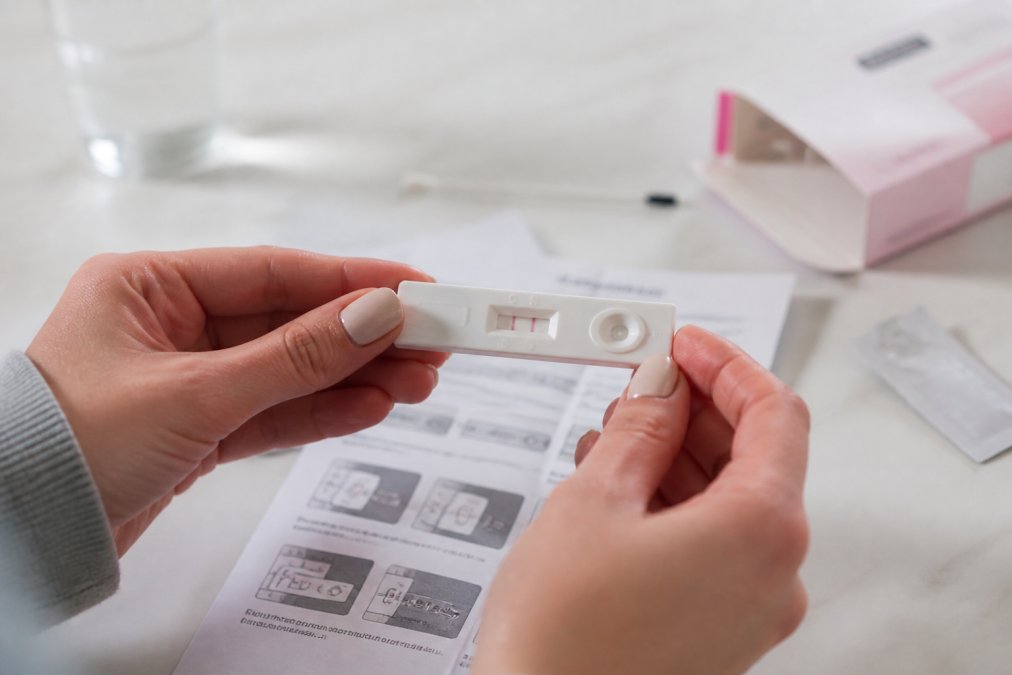
Timing matters when reading results. Most tests have a specific window, typically 10-15 minutes, during which results are valid. Reading too early may show a false negative because the reaction hasn't completed. Reading too late may show a false positive if the test reagents have degraded or the sample has dried unevenly. Follow the manufacturer's instructions precisely on timing.
Store the test at room temperature before use. Extreme temperatures degrade the reagents and compromise accuracy. If you've stored a test in a cold or hot environment, discard it and use a fresh one. The cost of a single test is minimal compared to the cost of a wrong result.
When to Follow Up With a PCR Test
A PCR (polymerase chain reaction) test is a molecular test that amplifies genetic material from the pathogen, making it far more sensitive than antigen detection. PCR tests can detect infection earlier and with lower viral loads than rapid tests. If your rapid test result conflicts with your symptoms or clinical suspicion, PCR testing provides confirmation.
You should consider PCR testing in these scenarios: you tested negative on a rapid test but have strong symptoms; you are immunocompromised and need higher diagnostic certainty; you are in a high-stakes situation where a false negative carries serious consequences; or you tested positive and want confirmation before making major decisions about isolation or treatment.
The tradeoff is time and cost. PCR tests require laboratory processing and typically take 24-48 hours for results. They are more expensive than rapid tests. But when diagnostic accuracy is critical, the investment is worthwhile.
Many healthcare providers now use a two-step approach: rapid test first for speed, PCR confirmation if the rapid result is unclear or conflicts with clinical presentation.
| Test Type | Result Time | Sensitivity | Cost | Best Use |
|---|---|---|---|---|
| Rapid Antigen | 10-15 minutes | 70-90% | Low | Initial screening, quick decisions |
| PCR/Molecular | 24-48 hours | 95-99% | Higher | Confirmation, early detection, immunocompromised |
Factors That Affect Rapid Test Accuracy
Multiple variables influence whether your rapid test result reflects reality. Sample collection quality is paramount. A shallow swab, insufficient time in the collection area, or improper technique produces low-quality samples that may yield false negatives even with a functional test.
Making the Right Decision After Your Rapid Test Results
Your rapid test result should inform your decisions, but it should not be your only input. Consider the full clinical picture: your symptoms, exposure history, vaccination status, and risk factors.
Frequently Asked Questions
Can a rapid test give a false negative result?
Yes. Rapid tests have a false negative rate that varies by condition and test type, typically ranging from 20-40% depending on viral load, timing, and swab technique. A false negative occurs when the test fails to detect a pathogen that is actually present. This is why timing matters: testing too early in the incubation period, before sufficient viral shedding occurs, significantly increases false negative risk. If symptoms persist or exposure is recent, follow-up with a PCR test is recommended.
How accurate are rapid health tests compared to PCR tests?
Rapid tests offer good specificity (fewer false positives) but lower sensitivity (more false negatives) than PCR tests. PCR tests use polymerase chain reaction technology to detect genetic material and are considered the gold standard for diagnostic accuracy. Rapid tests detect antigens directly and deliver results in 15-30 minutes, making them convenient but less reliable during early infection or low viral load periods. For critical health decisions, PCR confirmation is often recommended.
What should I do if my rapid test result is inconclusive?
An inconclusive or unclear result means the test didn't provide enough information to determine if you're positive or negative. Repeat the test after 24-48 hours using a fresh kit and proper swab technique, or contact a healthcare provider for a PCR test. Environmental factors, improper swab collection, or low viral load can all produce inconclusive results. Don't assume a faint or unclear line is negative; treat inconclusive results as requiring follow-up testing.
When is the best time to use a rapid test for accurate results?
Rapid tests work best when viral load is highest, typically 2-7 days after symptom onset or exposure. Testing too early in the incubation period, before the pathogen reaches detectable levels, increases false negative risk. If you test negative but have symptoms or known exposure, retest after 24-48 hours or use a PCR test for confirmation. Timing, proper swab collection technique, and following the kit's instructions exactly all affect diagnostic yield and reliability.