
Table of Contents
- How AI Skin Recommendation Technology Works
- AI Dermatologist App Accuracy: What Clinical Validation Shows
- The Limitations of AI in Dermatology You Should Know
- FDA Regulation of AI Medical Devices: What's Cleared and What Isn't
- Algorithmic Bias: Who AI Skin Analysis Gets Wrong
- When to Trust AI Skin Recommendations vs. See a Dermatologist
- Conclusion: Using AI as a Starting Point, Not a Diagnosis
- Frequently Asked Questions
Last Updated: September 23, 2026
How AI Skin Recommendation Technology Works
An AI skin recommendation is a personalized skincare suggestion generated by software that analyzes a photo of your face using computer vision and machine learning. It maps visible features, texture, tone, blemishes, fine lines, to product categories. It is not a diagnosis.
From Selfie to Skin Analysis: The Technical Pipeline
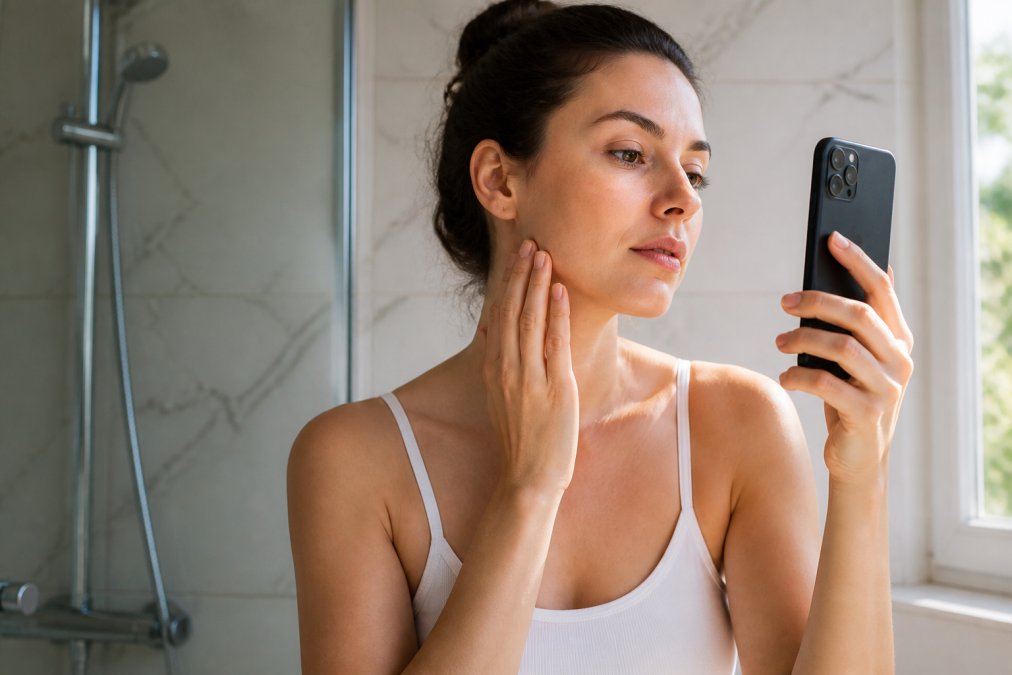
The weak link is almost always the input image, not the model. Phone cameras apply automatic white balance, sharpening, and HDR tone mapping before the app sees the file, distorting color and contrast in ways that shift how redness or dark spots get scored.
AI Dermatologist App Accuracy: What Clinical Validation Shows
Clinical validation for consumer skin apps is thinner than the marketing suggests. Most peer-reviewed work on AI skin analysis comes from academic or hospital settings using controlled capture rigs, fixed distance, cross-polarized lighting, color calibration cards, not phones held at arm's length in a bathroom.
Concordance Rates and Clinical Benchmarks
Concordance rate measures how often an AI system's output agrees with a dermatologist's assessment. It is the most quoted and most misread number in app marketing: a high rate on a narrow task, classifying one lesion type, for example, says nothing about how the system handles the full range of concerns a real face presents.
-
Reader studies: the model and a panel of dermatologists classify the same stored images. Cheap, easy to inflate, and the most common source of headline accuracy numbers.
-
Retrospective clinical studies: the model runs against images from real patient records, with pathology or biopsy as ground truth. Stronger, but not a live selfie.
-
Prospective trials: the model is deployed in a real workflow and compared to patient outcomes. Rare, expensive, and almost never done for consumer apps.
-
Task scope: one condition vs. broad skin analysis
-
Population: who was in the training and test sets, and whether skin tone distribution was reported
-
Capture method: controlled rig vs. consumer phone
-
Comparator: board-certified dermatologist vs. untrained labeler vs. another algorithm
-
Endpoint: diagnostic sensitivity and specificity vs. cosmetic scoring on a 1-5 scale
What the Regulatory Pathway Tells You About Accuracy
The FDA does not clear "AI skin analysis" as a category. It clears specific devices for specific intended uses, and the intended use statement is where the accuracy bar lives. A device cleared to triage lesions has been evaluated on sensitivity and specificity for that task; a consumer app that scores texture and suggests a serum has not been evaluated against anything, because it makes no medical claim.
The Bottom Line on Accuracy Claims
Accuracy is not a property of the model alone. It is a property of the model, the input image, the population it was tested on, and the task it was asked to perform, all four together. A claim that omits any of the four is incomplete, and incomplete accuracy claims are the most common thing you will encounter in this category.
The Limitations of AI in Dermatology You Should Know
The limitations of AI in dermatology fall into three buckets: what the camera cannot capture, what the model was never trained to see, and what no image can reveal at all.
Why Image Quality and Standardized Lighting Decide Results
Standardized lighting is the biggest controllable variable in consumer skin analysis: the same face under cool bathroom LEDs and warm window light will score differently for tone and redness.
Practical fixes that actually move the needle:
- Shoot in indirect daylight, facing a window, never with the sun behind you
- Remove makeup and wait 15 minutes after washing
- Hold the phone at a fixed distance and keep your expression neutral
- Take three shots and compare, rather than trusting a single frame
- Avoid the front-facing camera if it applies heavy beauty smoothing
FDA Regulation of AI Medical Devices: What's Cleared and What Isn't
The FDA regulation of AI medical devices is narrower than most people assume. A cleared device has met a specific intended-use claim, on a specific population, with defined performance thresholds. Clearance does not transfer to a consumer app that borrows the same algorithm.
Here is how the categories actually break down:
| Category | Regulatory Status | What It Can Claim | Typical Example |
|---|---|---|---|
| General wellness tool | Not a medical device | Lifestyle and cosmetic guidance | Habit and routine apps |
| Consumer skin scanner | Usually unregulated | Visual feature scoring | Selfie-based analysis apps |
| Cleared diagnostic device | FDA cleared or approved | Specific clinical detection | Lesion triage tools |
| Dermatologist-in-the-loop | Varies by workflow | Clinical decision support | Triage routing systems |
Algorithmic Bias: Who AI Skin Analysis Gets Wrong
Algorithmic bias in skin analysis is a documented, structural problem, the biggest gap between what consumer AI skin tools claim and what they deliver. The mechanism determines whether a given tool is likely to work on your skin.
Why Bias Happens: The Training Data Problem
Computer vision models learn what skin looks like from their training images. If those images skew toward lighter tones, the model's internal representation of "normal skin" skews with them, a data composition problem, not a moral failing, that shows up in nearly every public dermatology image dataset.
The consequences are specific and predictable:
- Redness detection fails on darker skin. Erythema, the redness that signals inflammation, rosacea, or irritation, presents differently on melanin-rich skin. A model trained to detect redness as a color shift from pale pink to red will miss it entirely on deeper tones, because the color shift is smaller in absolute pixel terms.
- Texture scoring over-flags darker skin. Some models interpret natural skin variation, follicular patterns, and post-inflammatory hyperpigmentation as "texture concerns," generating recommendations for problems the user does not have.
- Confidence is not calibrated to uncertainty. When a model encounters a phenotype outside its training distribution, it does not return "I don't know." It returns a confident score. That confidence is the failure mode, not a feature.
The Environmental Layer Most Tools Ignore
Bias is not only about skin tone; camera processing, lighting, and environment compound it. Phone cameras apply automatic white balance, sharpening, and HDR tone mapping before the app sees the file, and those corrections are tuned for the average user, distorting color and contrast differently depending on skin tone and ambient light.
How to Evaluate a Tool Before You Trust It
You cannot audit a model's training data from the outside, but you can ask questions that reveal whether the developer has thought about bias at all:
- Does the app ask for your skin tone or Fitzpatrick type? If it does not, it is treating all skin as equivalent, which is the definition of the problem.
- Does it report performance by skin tone? A serious developer publishes disaggregated accuracy. A marketing page does not.
- Does it flag low-confidence results? If every scan returns a confident score, the model is not calibrated.
- Does it recommend the same actives regardless of input? If the output barely changes when you change your inputs, the "AI" is a quiz with a skin on it.
What This Means for You
If you have deeper skin, textured skin, active inflammation, or visible scarring, treat consumer AI skin scores as directional at best. The tool may still track change over time on your own skin, your baseline is your baseline, but it is not a fair judge of what your skin "should" look like, because the standard it compares you against was built from a population that probably did not include you.
When to Trust AI Skin Recommendations vs. See a Dermatologist
Trust an AI skin recommendation for routine, cosmetic decisions: which cleanser suits oily skin, how to sequence actives, whether a moisturizer is heavy enough for winter. These are low-stakes calls where a wrong answer costs a wasted purchase.
Conclusion: Using AI as a Starting Point, Not a Diagnosis
AI skin analysis is useful as a starting point and unreliable as an endpoint. It can organize your routine, track visible change over time, and narrow a product search. It cannot examine what a photograph misses.
Frequently Asked Questions
Is AI skin analysis accurate enough to replace a dermatologist?
No. AI skin recommendation tools can flag patterns and suggest products, but they cannot replace a board-certified dermatologist. Clinical validation studies show AI performs well on specific, narrow tasks like lesion classification, yet accuracy drops when lighting, skin tone, or image quality varies. Use AI as a starting point for product ideas or triage, not as a final diagnosis. Any suspicious mole, changing lesion, or persistent irritation needs an in-person exam.
Can AI tell me what's wrong with my skin?
AI can identify visible surface patterns such as texture, hyperpigmentation, and sebaceous activity, but it cannot diagnose conditions like eczema, rosacea, or skin cancer on its own. Most consumer apps classify what they see against training data and return a probability, not a medical conclusion. If an app claims to diagnose, check whether the underlying model has FDA clearance for that specific use. Otherwise, treat the output as a hint, not a verdict.
Are AI skin apps regulated by the FDA?
Some are, most are not. The FDA regulates AI medical devices through its software-as-a-medical-device pathway, and only tools cleared for a specific diagnostic claim fall under that oversight. Many consumer skin apps market themselves as wellness or cosmetic tools to avoid that review. FDA regulation of AI medical devices is evolving, and a clearance for one condition does not cover others. Check the FDA's device database before trusting any diagnostic claim.
What are the limitations of AI-based skin analysis?
The biggest limitations of AI in dermatology are training data bias, inconsistent lighting, and lack of clinical context. A model trained mostly on lighter skin tones can miss conditions on darker skin phenotypes, producing false negatives. Poor lighting or a low-resolution selfie can trigger false positives. AI also cannot feel texture, ask about medical history, or see inside a lesion. These gaps are why dermatologist-in-the-loop review still matters for anything serious.